
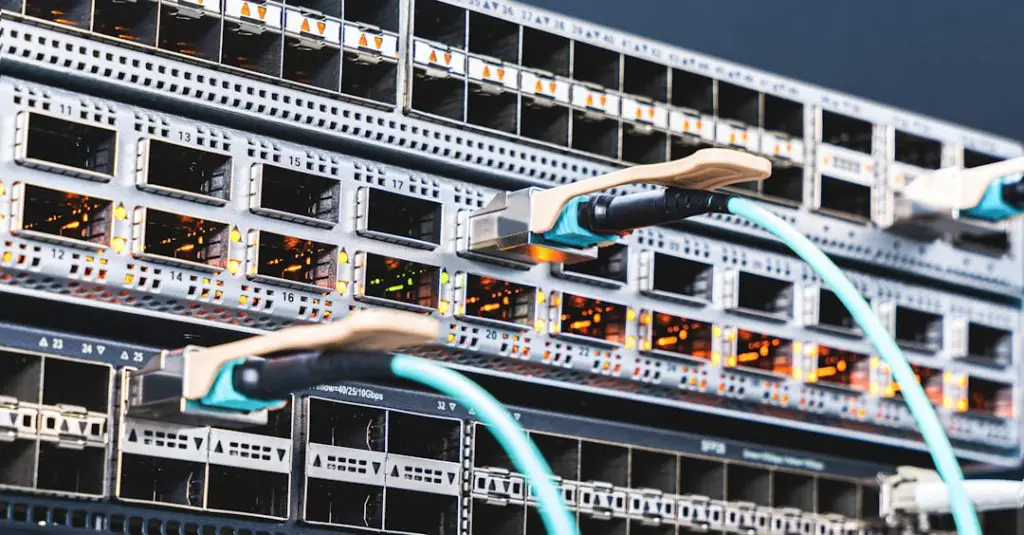
The modern world runs on light. Every video call, streamed movie, cloud backup, financial transaction, and AI query travels as pulses of laser light through hair-thin glass fibers buried under cities and oceans. For decades, engineers have squeezed more and more data into these optical highways, sustaining the explosive growth of the internet. But a pressing question looms over the telecommunications industry: Are we running out of light? Or more precisely, are we approaching a fundamental “capacity crunch” in fiber optic communication?
TL;DR: Global data traffic is growing exponentially, pushing fiber optic networks toward their physical limits. While engineers have dramatically increased capacity using wavelength multiplexing, advanced modulation, and amplification techniques, fiber channels are constrained by noise, nonlinear effects, and Shannon’s capacity limit. Researchers are developing new approaches such as space division multiplexing and hollow core fibers to avoid a future bandwidth bottleneck. The “capacity crunch” is not imminent, but physics—not economics—may ultimately set a ceiling.
The Spectacular Rise of Fiber Optics
Since the 1980s, fiber optics has replaced copper wires as the backbone of global communications. Optical fibers transmit information as pulses of laser light through ultra pure strands of glass. Because light travels incredibly fast and experiences very low loss in glass, fiber optics enables data transmission over thousands of kilometers with minimal amplification.
The early systems transmitted a single wavelength of light down each fiber. But innovation quickly advanced. Engineers discovered ways to send multiple colors (wavelengths) simultaneously through a single strand without interference. This technique, known as Wavelength Division Multiplexing (WDM), multiplied capacity dramatically.

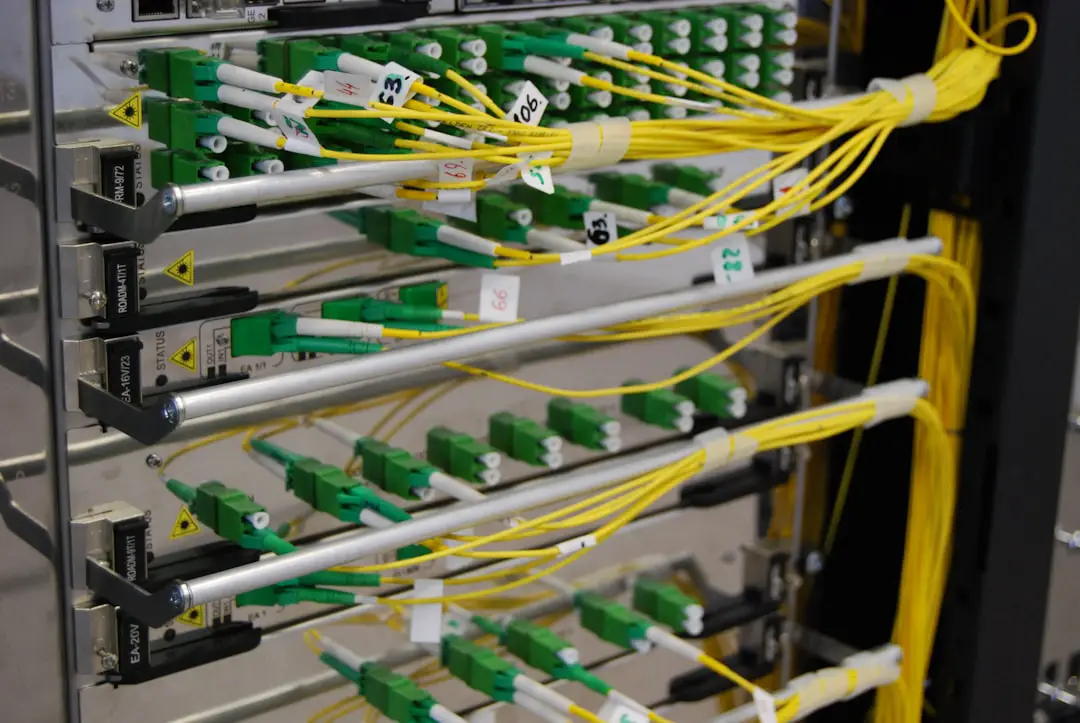
Over time, additional breakthroughs further increased throughput:
- Dense Wavelength Division Multiplexing (DWDM): Dozens or even hundreds of wavelengths in one fiber.
- Advanced modulation formats: Encoding more bits per pulse by altering amplitude, phase, and polarization.
- Erbium doped fiber amplifiers: Boosting signals without converting light into electricity.
- Coherent detection: Using sophisticated receivers and digital signal processing to recover weak signals.
These innovations have pushed fiber capacity from megabits per second in the 1980s to terabits per second per fiber today. This exponential growth has roughly tracked internet demand for over four decades.
Why a Capacity Crunch Is Being Discussed
Global internet traffic continues to rise at staggering rates. Ultra high definition streaming, cloud computing, remote work, smart devices, 5G infrastructure, and AI workloads all consume enormous bandwidth. Data centers now exchange petabytes per second. Submarine cables crossing oceans carry hundreds of terabits per second.
However, unlike computing power—which once followed Moore’s Law—fiber capacity cannot increase indefinitely. At some point, physics imposes limits.
The potential crisis is called the optical capacity crunch: the fear that future data demand will outpace our ability to transmit information through existing fibers.
The Physics Behind the Limit
The fundamental constraint comes from information theory. In 1948, Claude Shannon introduced a formula that defines the maximum information rate of a communication channel given its bandwidth and noise level. This is known as the Shannon Capacity Limit.
In simplified terms:
Capacity increases with bandwidth and signal to noise ratio—but both are limited in real optical fibers.
1. Limited Bandwidth of Fiber
Optical fibers do not support infinite wavelengths. Only specific low loss windows—primarily the C-band and L-band—are suitable for long distance transmission. These occupy a finite portion of the electromagnetic spectrum.
Even if more wavelengths are packed closely together, a hard spectral boundary remains.
2. Amplifier Noise
Signals traveling long distances weaken and require amplification. Optical amplifiers introduce noise, which cannot be removed. This degrades the signal to noise ratio and limits how much data can be encoded.
3. Nonlinear Optical Effects
Unlike radio waves in free space, light in fiber interacts with the medium itself. At high power levels, optical signals produce nonlinear effects such as:
- Self phase modulation
- Cross phase modulation
- Four wave mixing
These distort signals and create interference between channels. Ironically, increasing signal power to overcome noise can worsen these nonlinear distortions.


4. The Fundamental Tradeoff
There exists a delicate tradeoff between signal power and noise. Increase power too much, and nonlinear distortions dominate. Reduce power too much, and amplifier noise overwhelms the signal. The sweet spot defines a finite optimal capacity.
Laboratory experiments suggest that many modern long haul fibers are approaching within a factor of two of their theoretical Shannon limits. That means the era of easy exponential scaling may be ending.
How Close Are We to the Limit?
Importantly, the world is not about to “run out of internet.” Many installed fibers are not fully utilized. Infrastructure upgrades, better coding techniques, and new equipment can still extract incremental gains.
However, from a physics standpoint, capacity increases are becoming harder and more expensive. The dramatic 10x leaps of past decades are being replaced by incremental improvements.
The concern is especially serious for submarine cables, where replacing physical fibers is extraordinarily expensive and logistically challenging.
Potential Solutions to the Crunch
Researchers are exploring multiple strategies to extend or bypass current limits.
1. Expanding Usable Spectrum
New amplifiers are being developed for additional spectral bands beyond the traditional C and L bands. Utilizing S-band or other regions could widen the available bandwidth.
2. Space Division Multiplexing (SDM)
If more wavelengths cannot fit into a single core, engineers can send light through multiple spatial channels.
- Multi core fibers: Several cores inside one fiber strand.
- Few mode fibers: Multiple propagation modes within one core.
This effectively multiplies capacity by adding parallel paths.


3. Hollow Core Fibers
Traditional fibers guide light through solid glass. Hollow core fibers guide light through air, significantly reducing nonlinear effects and latency. Early experiments show promise for higher power transmission with fewer distortions.
4. Better Digital Signal Processing
Advanced algorithms and machine learning techniques can compensate for distortions and operate closer to theoretical limits.
5. Laying More Fiber
The simplest solution is brute force: install more fibers. While expensive, parallel infrastructure avoids pushing single fibers to extreme limits.
Is This the End of Exponential Growth?
Historically, telecommunication systems have repeatedly overcome predicted limits. When copper cables saturated, fiber replaced them. When single wavelengths maxed out, multiplexing expanded capacity.
However, the difference today is that we are confronting fundamental physical constraints, not engineering inefficiencies. Shannon’s limit is inviolable under classical communication theory.
Some researchers suggest that entirely new paradigms, such as quantum communication networks or radically different materials, may redefine limits. Yet for conventional fiber systems, improvements are likely to be incremental rather than explosive.
Economic vs. Physical Limits
It is crucial to distinguish between economic constraints and physical ones:
- Economic limit: When upgrades cost more than the revenue they generate.
- Physical limit: When no further increase is possible regardless of investment.
Today’s networks are approaching economic tension before absolute physical ceilings. Yet long term projections suggest physics will eventually dominate planning decisions.
What This Means for the Future
Rather than a dramatic blackout event, the “capacity crunch” would likely manifest as higher infrastructure costs, slower improvement cycles, and more complex engineering tradeoffs.
Innovation will continue—but squeezing the next doubling of capacity may require disproportionately more effort than previous generations.
In essence, humanity is not running out of light. Instead, it is approaching the limits of how efficiently light can be used inside tiny glass strands governed by immutable physical laws.
The future of connectivity will depend on how ingeniously scientists navigate those limits.
FAQ
Are we literally running out of light?
No. The issue is not a shortage of photons, but the limited capacity of fiber optic channels to transmit information without excessive noise and distortion.
What is the Shannon Limit?
The Shannon Limit defines the maximum data rate of a communication channel given its bandwidth and signal to noise ratio. It represents a fundamental theoretical ceiling.
Is the internet going to slow down?
Not imminently. However, future capacity improvements may become more gradual and costly compared to past decades.
What is Space Division Multiplexing?
It is a technique that increases capacity by transmitting signals through multiple spatial paths, such as multiple cores within a single fiber.
Can quantum communication solve the problem?
Quantum technologies may transform secure communication, but they do not currently provide a direct solution to classical capacity limits in conventional fiber systems.
Why not just lay more fiber?
That remains a viable approach, but submarine installations and urban deployments are extremely expensive and time consuming.
Is a global bandwidth collapse likely?
No. The concern centers on long term scalability and cost pressures, not a sudden failure of global networks.